On the Shelf: April 2022 reads

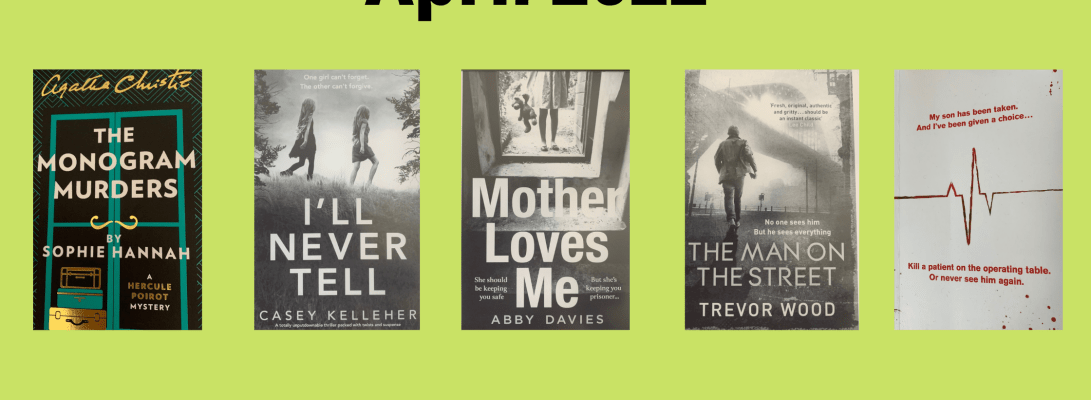
In April 2022, I read a lot of crime fiction:

  • The Monogram Murders by Sophie Hannah
  • Mother Loves Me by Abby Davies
  • I’ll Never Tell by Casey Kelleher
  • The Man on the Street by Trevor Wood
  • Do No Harm by Jack Jordan (proof).

And one book for research:

  • Clay Models and Stone Carving by Irene Dancyger.

The Monogram Murders is the first in Sophie Hannah’s continuation of Agatha Christie’s Poirot series. True to Agatha Christie’s style, this is a golden-age puzzle mystery involving three apparently identical (but not in Poirot’s eyes!) murders in a London hotel. It will keep you guessing from start to finish and was a lot of fun to read.

I appeared on a Facebook Live panel for the UK Crime Book Group in April with fellow crime writers, Casey Kelleher and Abby Davies. I had already read Abby’s latest book, The Cult, so took the opportunity to read her debut Mother Loves Me. The Cult was one of my favourite books last year and Mother Loves Me is also brilliant. Both books are intense, creepy and claustrophobic. Recommended!

Casey’s latest novel I’ll Never Tell is a departure from her gangland novels and I really enjoyed it. Both writers are really good at capturing a child’s voice and creating gripping and disturbing narratives. There are some great twists in I’ll Never Tell.

I was a little apprehensive about reading The Man on the Street because I work in the homelessness sector, and I was worried about how it might be portrayed. I have to say that Trevor Wood is spot on with his empathetic depiction of life on the streets, the characters, some of the situations they end up in and the challenges they face. This was a great thriller with fantastic characters, and I particularly loved the inclusion of Dog. I am looking forward to reading the rest of the series.

I picked up Do No Harm by Jack Jordan at Theakston’s Old Peculier Crime Festival in Harrogate last summer, but I have only just read it. This is a high-octane thriller from the start which leaves the reader constantly asking the question ‘what would I do in this situation?’. I liked the way all the characters were flawed in some way, but you were still rooting for them.

I borrowed Clay Models and Stone Carving from the library for some research into one of my characters for book four. He is a stone mason, so I needed to understand exactly how you go about sculpting stone. It was completely fascinating and made me really think about the structures I walk past every day without noticing!

Fairy tales and crime fiction

Crime writers are rarely in the business of delivering happy endings, but our books may have more in common with fairy tales than we think.

Reading some classic children’s stories to my young nephew I was struck by how much criminality lay between the pages of these seemingly innocent bedtime yarns.

Next time you’re stuck for a plot, you could do worse than peruse your children’s bookshelves for inspiration.

BURGLARY AND TRESPASS – GOLDILOCKS AND THE THREE BEARS

Is it any surprise that the three bears are angry when they come back from their walk not only to discover someone has broken into their property, but also eaten their food and slept in their beds?

In one of the original endings to this tale, the bears throw Goldilocks onto the fire in retribution. The 21st century version is much tamer – Goldilocks runs away. Let’s hope she didn’t leave any fingerprints…

KIDNAP – HANSEL & GRETEL

The Witch lures Hansel and Gretel into her house with the promise of gingerbread. Once there she captures her young victims and puts her cauldron on the stove, intending to eat them.

Kidnap with a threat of cannibalism – and we read these stories to children?

POISON – SNOW WHITE

Toxic relationships are a common theme in both fairy tales and crime fiction. As the saying goes, you can choose your friends, but you can’t choose your family!

Snow White’s jealous stepmother puts her to sleep with a poisoned apple. Modern day equivalents might be Rohypnol or GHB.

INTIMIDATION – THE THREE LITTLE PIGS

‘Let me in, let me in, or I’ll blow your house down!’ cries the wolf outside the little pig’s door. Intimidation is one of the building blocks of a good thriller.

GASLIGHTING – THE EMPEROR’S NEW CLOTHES

The Emperor loves his clothes – so much so that he is easily tricked into believing in a special cloth that only wise men can see. Everyone around him keeps quiet as the naked Emperor parades around the town in his birthday suit. A lesson in vanity or a pitiable victim of fraud?

These days you are perhaps more likely to fall foul of cyber fraud – online retailers selling you something that doesn’t exist. Or how about creating a rich, influential character that no one dare stand up to?

Some plot devices found in fairy tales will feel very familiar to crime writers:

THE UNINVITED GUEST – SLEEPING BEAUTY

The doors are closed, the party has begun, but is there a killer among the guests? The premise of the closed-door mystery has a lot in common with the opening to Sleeping Beauty.

THE TICKING CLOCK – CINDERELLA

If Cinderella hadn’t had to leave the ball by midnight, there would be no tension in the story. She could have danced with the Prince all night, left her number and lived happily ever after. That midnight deadline is what makes all the difference. No time to stop and pick up your shoe, Cinders, get out of there before disaster strikes!

AN OFFER YOU CAN’T RESIST – PINOCHHIO

Pinocchio is all set to go to school like a real boy when he encounters the fox and the cat who tempt him to go to the fair instead. Things go badly wrong and get even worse when Pinocchio tries to lie his way out of his predicament. The only thing that can save him is listening to his conscience and telling the truth. Good job our characters don’t feel the same way, otherwise there wouldn’t be much mystery!

THE QUEST – THE BRAVE LITTLE TIN SOLDIER

In many fairy tales the heroes are put to the test before they can achieve their goal. Similarly, detectives have to overcome a series of obstacles before they can unmask the killer.

Spare a thought for The Brave Little Tin Soldier. He falls out of a window, nearly drowns, is swallowed by a fish, thrown into a stove, and set alight before he wins his true love.  

All writers know the importance of an atmospheric setting in our fiction, and fairy tales are no exception.  

INTO THE WOODS – LITTLE RED RIDING HOOD

Some of the best fairy tales are set in woodland for a very good reason. Darkness, shadows, plenty of places to hide. The forest serves as a departure from the safety of home and a threshold to adventure.

Little Red Riding Hood, Hansel and Gretel, and Goldilocks are all tales of disobedience and straying too far off the path. In the modern era, it’s also a good way of losing your 4G…

CASTLES – THE PRINCESS AND THE PEA

The castles in fairy tales are often occupied by people of great power and privilege. To gain entry, peasants have to be very clever or very beautiful. The contrast between rich and poor, and the abuse of power and privilege, is fertile ground for crime fiction writers.

TOWERS AND LOCKED ROOMS – BEAUTY AND THE BEAST / RAPUNZEL

Always check your exit! The creepy castle or mansion house is a stalwart of crime fiction for good reason. Once you’ve entered, it’s not always that simple to escape. Rapunzel grows her hair to evade her capture while Beauty wins over the Beast. Modern day criminals might not be quite so easy to win round.

At the heart of every fairy story is a morality tale. Perhaps crime fiction is the contemporary equivalent?

This article was first published in Red Herrings, the magazine for members of The Crime Writers Association.

Photo by Cederic Vandenberghe on Unsplash

On the Shelf: March 2022 reads

In March 2022, I read:

  • The Dying Day by Vaseem Khan (The Malabar House Mysteries #2)
  • Bullet Train by Kotaro Isaka
  • The House of Killers by Samantha Lee Howe
  • Kill or Die by Samantha Lee Howe
  • Lives of the Stoics by Ryan Holiday and Stephen Hanselman

The Dying Day by Vaseem Khan is the second in The Malabar House Mysteries starring Inspector Persis Wadia. Set in post-partition Bombay, this thriller revolves around the disappearance of a precious manuscript. A series of riddles sets our intrepid detective on the trail of a murderer.

I really enjoyed the historical detail in this novel and the way it is weaved around a gripping plot but mostly I just love the character of Persis and her budding relationship with forensic scientist Archie Blackfish. I’m really looking forward to the next one in the series.

Then it was all about the assassins!

I started by reading Bullet Train by Kotaro Isaka. Five assassins are on a bullet train all with different agendas. The experience of reading this book was a lot like watching a Quentin Tarantino film. I loved the characters particularly the sinister teenage killer, The Prince. I read this in one sitting and was completely gripped from start to finish.

I have also been watching Killing Eve, season four on BBC One. If you’re a fan of the series, I would highly recommend The House of Killers trilogy by Samantha Lee Howe.

The first of the series, The House of Killers, was a re-read for me. It’s a twisty read featuring female assassin Neva and MI5 agent Michael who are irresistibly drawn to each other. I am now about two thirds of the way through the second book, Kill or Die and really enjoying it.

On a completely different note, I am also reading Lives of the Stoics by Ryan Holiday and Stephen Hanselman. I am finding it fascinating to read about the lives of Ancient Romans and Greeks who practised Stoicism. It’s amazing how many parallels there are between their lives and modern lives. We still seem to be wrestling with the same problems!

On the Shelf: February 2022 reads

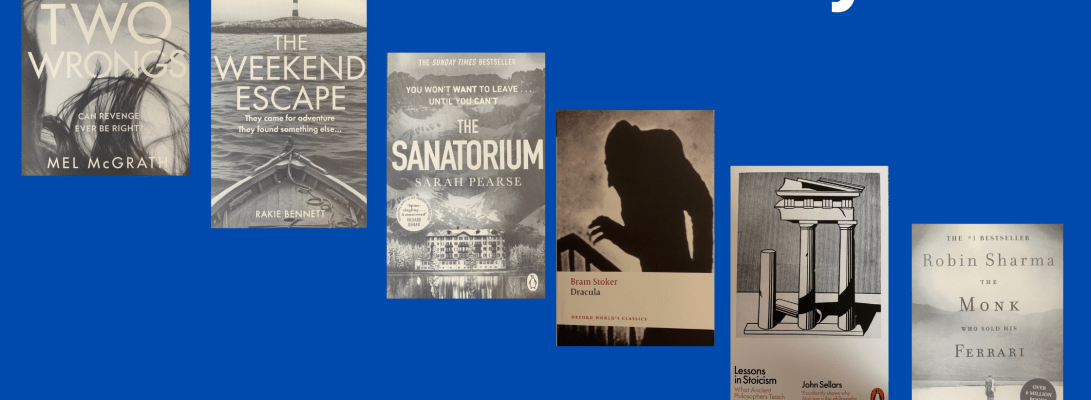
In February 2022, I read an eclectic mix of books: three psychological thrillers, a classic and a couple of non-fiction titles.

I read:

  • Two Wrongs by Mel McGrath
  • The Weekend Escape by Rakie Bennett
  • The Sanatorium by Sarah Pearse
  • Dracula by Bram Stoker
  • The Monk who sold his Ferrari by Robin Sharma
  • Lessons in Stoicism by John Sellars

The psychological thrillers all had very different settings – Two Wrongs is set in a fictional university and involves a spate of suicides among female students; The Weekend Escape is set on a stormy island off the coast of North-West England; and The Sanatorium is set in a creepy hotel, a former sanatorium, in snowy Switzerland. I enjoyed them all, but The Weekend Escape was my favourite as it was so fast paced!

I bought Dracula on a recent trip to Whitby. I hadn’t read it before, and I thoroughly enjoyed it. I particularly liked the character of Mina and the use of setting and atmosphere to add to the tension. I thought Stoker made effective use of multiple narration and I liked how the story unfolds through different perspectives.

I read The Monk who sold his Ferrari by Robin Sharma after reading The 5AM Club. There is quite a lot of cross-over between the two books, but both are worth reading, particularly if you are looking for some focus in a very distracting world! At the heart of The Monk who sold his Ferrari is a rather odd allegory involving a garden, a lighthouse and a sumo wrestler (!) which is, at the very least, memorable! I have tried to adopt some of the principles Sharma advocates, but I am finding the early starts very challenging to stick to.

Lessons in Stoicism is quite a short book and very much an introduction to Stoicism. It was an enjoyable read but I would have preferred something more in-depth as I was familiar with most of the concepts in it.

I am now turning my attention to The Dying Day by Vaseem Khan, who is rapidly becoming one of my favourite writers. This is the second in the Malabar House mystery series set in post-partition India and it is really good so far! I love the main character, Inspector Persis Wadia, and all the historical details which feel meticulously researched.  

What are you reading this month?

On the Shelf: January 2022 reads

I started 2022 with some cracking reads!

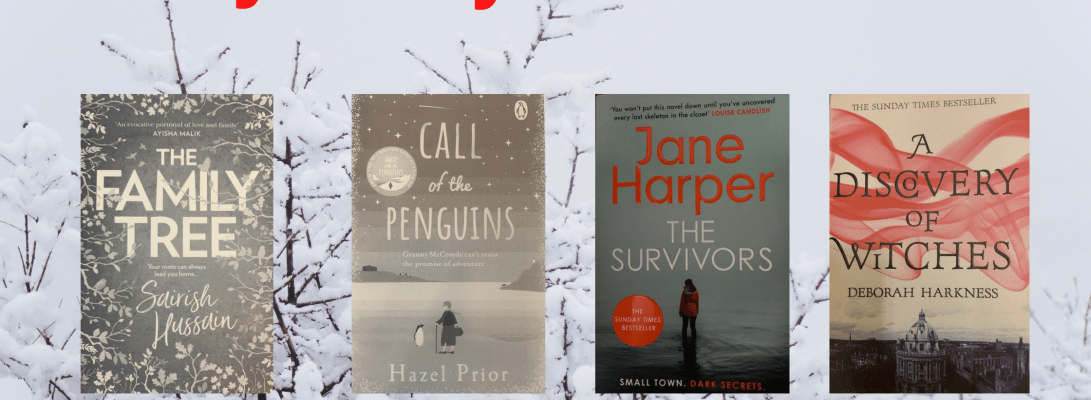
In January, I read:

  • The Family Tree by Sairish Hussain
  • Call of the Penguins by Hazel Prior
  • The Survivors by Jane Harper
  • A Discovery of Witches by Deborah Harkness

The Family Tree is a story of love, loss and family. Amjad is a single dad raising his children with the help (and interference) of their grandmother. The opening chapter is particularly poignant as Amjad cradles his baby daughter, overwhelmed by the sense of responsibility of looking after two young children while struggling with his grief.

The novel then follows the family over the next 20 years as the children grow up and become young adults, navigating the complexities of race, religion and family in a West Yorkshire city. I have worked in Bradford for nearly the entire time covered in this book, so I knew a lot of the locations and events, and I enjoyed reading about them from a different perspective. I loved the way the storylines were weaved together, and I was rooting for all the characters. Recommended.

Call of the Penguins is the sequel to Away with the Penguins which I thoroughly enjoyed last year. Octogenarian Veronica McCreedy is now the star of a TV documentary and travels to the Falklands with her charming co-host, nine-year-old Daisy. There are relationship problems between Terry and Veronica’s grandson Patrick to sort out and a journey into the past as he searches for more information about his father. I can’t get enough of this series. I hope there’s another book on the way!

The Survivors is set in a coastal town in Tasmania and Harper’s descriptions of the windswept coastline are superb. A body is found on the beach and links are soon drawn to a teenaged girl who went missing years ago. Everyone in the town has something to hide, including Keiran who has recently returned to help his parents move house. This is a classic whodunnit, but while I enjoyed the mystery, it was the setting that really made this book for me.

I think I have read A Discovery of Witches at least 10 times now! For me, it’s very much a comfort read, an escape from the real world and into one dominated by witches, vampires and daemons. The first of a trilogy, A Discovery of Witches takes us to Oxford, rural France and the Highlands of Scotland all from the perspective of ‘creatures’ who live in plain sight. I think what I love about this series is that it is unashamedly academic – there are so many details of history, genetics, religion and science that are weaved together in this parallel universe.

Another book I read was The 5AM Club by Robin Sharma but I think I need a separate blog post for that! I will see if I can stick with it for a bit longer first.

On the shelf: December 2021 reads

In December, I read:

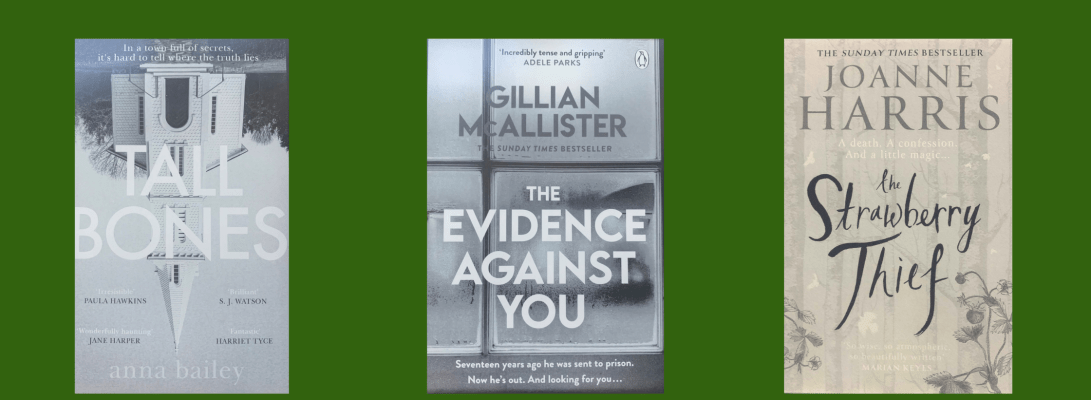
  • Tall Bones by Anna Bailey
  • The Evidence Against You by Gillian McAllister
  • Explore Everything: Place-hacking the city by Bradley L Garrett (non-fiction)
  • The Switch by Beth O’Leary
  • The Strawberry Thief by Joanne Harris

I bought Tall Bones after hearing Anna Bailey speak at the Theakston’s Old Peculier Crime Festival in Harrogate last summer. This atmospheric, haunting and chilling debut novel is set in small-town America and revolves around the disappearance of a 17-year-old girl after a party in the woods. The depiction of teenagers in a rural setting felt very authentic to me and I really enjoyed the twists and turns and the shocking reveal. However, for me, it was the characters that really made this novel special and I’m very much looking forward to her next book.

If you are an aspiring writer, I would recommend Gillian McAllister’s The Honest Authors Podcast, which she co-hosts with Holly Seddon. I really enjoyed The Evidence Against You – the protagonist’s father was convicted for the murder of her mother seventeen years ago, but was he innocent? After being released from prison, he wants to reconcile with his daughter and tell her the truth, but can she trust him? I loved the central relationship between father and daughter as they tried to come to terms with their past and discover what really happened.  

Explore Everything is a book about urban exploration that I read for research for my next novel. I found this book fascinating and it really made me question issues such as property ownership, our surveillance society, and the ethics of trespass.

The Switch by Beth O’Leary was a fairly light read, set in Yorkshire and London, and is about an urban twenty-something who swaps lives with her grandmother in the Yorkshire Dales. I preferred The Flat Share by the same author, but this was still an enjoyable read.

I’m a big fan of Joanne Harris and The Strawberry Thief matched up to my high expectations. The latest in the Chocolat series, this is about the younger daughter of Vianne Rocher, Rosette. When an old man leaves his woodland to the innocent teenager, old secrets and rivalries emerge. It made me realise that I have missed one of the books in this series, so I need to go back and read The Lollipop Shoes. I love the way Harris weaves magic into her novels and I found myself completely immersed in her world. It was an excellent book to herald the new year.

On the shelf: November 2021 reads

In November, I read:

  • Ask No Questions by Claire Allan
  • The Art of War for Writers by James Scott Bell (non-fiction)
  • Haven’t They Grown by Sophie Hannah
  • The Catcher in the Rye by J D Salinger
  • We Can’t All be Astronauts by Tim Clare (non-fiction)

I have read all of Claire Allan’s psychological thrillers and enjoyed them. Ask No Questions wasn’t my favourite, but it was still an interesting read about a journalist investigating the death of a young girl 20 years ago. Has there been a miscarriage of justice or was the right man sent to prison for the crime? 

The Art of War for Writers has lots of great advice for writers, delivered in very short chapters (some only a page or two). It’s a book I will probably dip into again when I need some inspiration.

Haven’t They Grown has a really intriguing premise – what if you saw a friend that you had lost touch with 12 years ago and her children hadn’t changed a bit? My brain was on overdrive reading this psychological thriller and trying to guess the answer.

One of the teenaged characters in my next book is reading The Catcher in the Rye, so I wanted to make sure I got the references right. I haven’t read this book for years and I had forgotten most of it. Nothing really happens, to be honest, but it’s a great example of voice and character in action.

I have been following and enjoying Tim Clare’s podcast, Death of 1,000 cuts, particularly his ‘Couch to 80k bootcamp’ which really helped me kickstart my writing when I got stuck. We Can’t All be Astronauts follows Clare’s journey to becoming a published writer. You can’t say he didn’t pull out all the stops, from infiltrating London Book Fair pretending to be a publisher, to appearing on a TV reality show. Really funny in parts, but there is also a very serious side as Clare explores the impact of his mental breakdown and how writing aided his recovery. A lot to think about in this highly engaging memoir.

Dream Big, Act Now: The benefits of life coaching for authors

Don’t get your hopes up.

It’s something we get told all the time as writers. Don’t get your hopes up and then you won’t be disappointed.

It’s well meaning. A way of protecting our self and others, but it’s also limiting. So it was fantastic to finally hear someone deliver the opposite message.

How about having a big dream? An impossible dream? A once-in-a-lifetime, million-to-one dream? How about dreaming of becoming a bestselling author?

And, crucially, taking steps towards that dream while 100% believing that you will achieve it one day.  

Comparing yourself to other authors? Fine, if they inspire you to work harder. Dealing with rejection? OK, it happens. What can we learn from it? Handling a tricky negotiation with your editor or agent? Bring it on.

The Dream Author coaching programme, run by Sophie Hannah – a bestselling author herself – isn’t about learning craft. There are lots of brilliant courses out there that will teach you everything you need to know about plot, character, structure, theme, etc. And it’s important to take the time to learn these things, particularly if you have just started to write.

Life coaching is more about managing your emotional and psychological responses to writing and publishing, dealing with the rollercoaster ride of your creative journey, learning to deal with agents and publishers, handle rejection and accept the ups and downs of a professional writing life with equanimity.

It’s bigger than that though. The tools you learn through the course will help you in all aspects of your life including work, relationships, home, health and money.  

The 14-month course comprises weekly webinars and exercises to work through. Sophie offers coaching via email or through the webinar where your issues can be raised anonymously and discussed. This is incredibly positive, and I recommend everyone to take advantage of it.

The course deals with issues such as procrastination and motivation (Sophie’s a big fan of scheduling); money and the business side of writing; making good decisions; celebrating success and constantly working towards your dreams.

Am I a bestselling author because I signed up to the Dream Author programme? No.

Am I working towards my dream goal while believing 100% that I will achieve it one day? Absolutely.

You can find out more about the Dream Author coaching programme here: Dream Author Coaching with Sophie Hannah | Find Out More

Photo by Lucas Clara on Unsplash

NaNoWriMo 2021: The final week

I finally finished my NaNoWriMo challenge on 4 December.

NaNoWriMo stands for National Novel Writing Month. It is an international challenge to write 50,000 words in November.

Knowing that I would find that difficult to achieve, I set myself a goal of adding 18,000 words to an existing manuscript that will hopefully turn into book four.

22 November – day 25

Goal: 539 words                               Achieved: 564 words                                      Total: 12,625

Intended to get up early to write before work but ignored the alarm and went back to sleep! Managed 564 words quite easily after dinner. A new plot line so very sketchy and will need fleshing out.

23 November – day 26

Goal: 475 words                               Achieved: 414 words                                      Total: 13,039

I went to a café on the way to work this morning and wrote 414 words by hand. I also made a lot of notes about one of my characters (a local MP) and her backstory. I really like this character and although she is no longer a POV character, I think I will want to use her again in another novel further down the line.

24 November – day 27

Goal: 961 words                               Achieved: 1,529 words                                  Total: 14,568

Another virtual write-in with my writing group this afternoon. We meet over Zoom, chat about writing for a bit and then do some focussed writing, checking in every 90 minutes or so to cheer each other on.

1.30pm – 2.30pm

Session one – merrily typing away when I came to a section that was basically a long rant and no longer relevant to the plot. Had to delete about 500 words which put me right back to the beginning again so only managed to add 119 words. ☹

4.15pm – 4.45pm

Session two – Added another 315 words. Definitely taking one step forward and two steps back at the moment and deleting a lot of words as I go along.

7.30pm – 8pm

Session three – lifted another chapter from the first draft, adding another 1,095 words. Needs some tidying up though.

25 November – day 28

Goal: 532 words                               Achieved: 572 words                                      Total:  15,140 words

Day off. A productive day with a chat with my agent this morning and lots of stuff done on the new house but unfortunately not many words written. Eventually I forced myself to write in the evening and managed 572 words – a new chapter towards the end of the book.

26 November – day 29

Goal: 360 words                               Achieved: 819 words                                      Total: 15,959 words

Planned out the chapter by hand at lunchtime then wrote up my notes while cooking dinner. Had to delete some of the words I wrote yesterday but added another 379 words in about half an hour.

After tea I took some more words from my first draft and copied and pasted them into the manuscript, adding another easy 440 words. Happy days! Just over 2,000 words to do now before the end of November.

27 November – day 30

Goal: 541 words                                               Achieved: 0                                        Total: 15,959 words

Horrendous night and day thanks to Storm Arwen which cut off our power. No words written as I tried to sort out the house and heating, etc.

28 November – day 31

Goal: 0 words                                                    Achieved: 0                                        Total: 15,959 words

Family day, no words planned. At this rate, I am not going to hit my target. Another bad day weather-wise and ended up staying with relatives instead of going home so no words written again.

29 November – day 32

Goal: 541 words                                               Achieved: 896 words                      Total: 16,855 words

Moved across the final bit of text from the first draft and by doing so, built up the word count by 896 words. The last half of the book still needs a lot of editing.

30 November – last day of NaNoWriMo!

Goal: 1,145 words                                           Achieved: 0                                        Total: 16,855 words

I don’t think I am going to achieve this goal and hit 18,000 words but I’m going to try!

4 December

Goal: 1,145 words                                           Achieved: 1,151 words                  Total: 18,006 words

I finally hit my target on Saturday, 4 December, finishing the challenge with 1,151 words.

The manuscript now stands at 60,006 words. I don’t think I am going to have much chance to work on this again until April, as I will be working on book three.

It definitely worked for me to set a smaller target than the suggested 50,000 words and I enjoyed tracking my progress on the website.

Did you do NaNoWriMo this year? How did you get on?

Photo by Thought Catalog on Unsplash