On the shelf: March 2021 reads

In February 2021 I read:

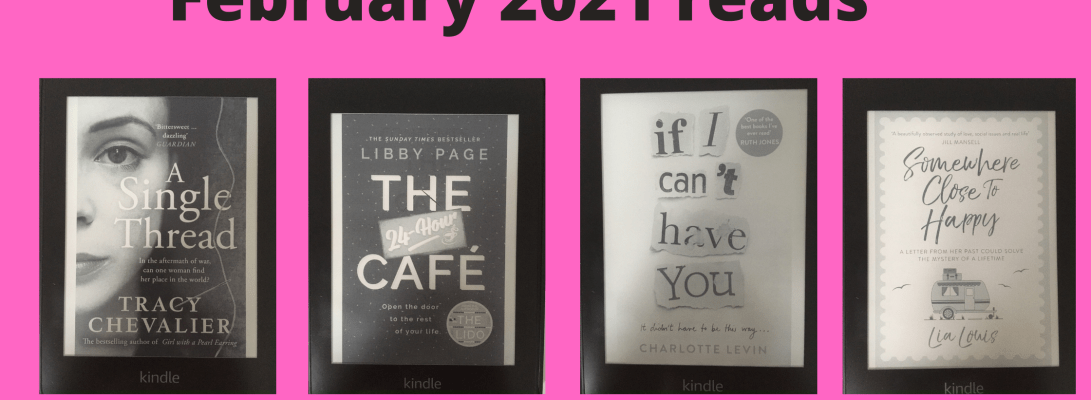
  • Somewhere Close to Happy by Lia Louis
  • If I Can’t Have You by Charlotte Levin
  • The 24-hour Café by Libby Page
  • A Single Thread by Tracy Chevalier
  • Girl at Christmas by Rhoda Baxter
  • Money: A User’s Guide by Laura Whateley (non-fiction)
  • The Big Four (Hercule Poirot #5) by Agatha Christie
  • The Choice by Alex Lake
  • All my Lies by Sophie Flynn (proof – to be published in April 2021)
  • The Success Code by Amanda Dewinter (non-fiction)

The stand-out title for me was A Single Thread by Tracy Chevalier, one of my favourite writers. Chevalier can make just about any subject fascinating, so although bell ringing and embroidery are by no means my favourite things, I found myself drawn into this world. The novel is set in 1932 and I really enjoyed reading about that period and the expectations of women and their roles in society between the two world wars.

All My Lies was a proof, kindly sent out in advance of the publication date of April 2021. A psychological suspense, set in Oxford and Cornwall, I really enjoyed this debut novel. Great characters, evocative writing, interesting locations and a page-turning plot with plenty of twists and turns.

The Agatha Christie was not for me. I found the premise completely ridiculous to be honest!

The other stand-out title for me was The Success Code by Amanda Dewinter. I found it quite inspiring and a practical approach to defining your goals and working towards them. I particularly liked the emphasis on self-care and looking after yourself so that you don’t burn out.

In March, I am planning to read:

  • The Last Snow by Stina Jackson
  • The Chain by Adrian McKinty
  • How to Disappear by Gillian McAllister
  • The Hit List by Holly Seddon
  • Someone We Know by Shari Lapena

Have you read any of these? What did you think of them?
On the shelf: February 2021 reads

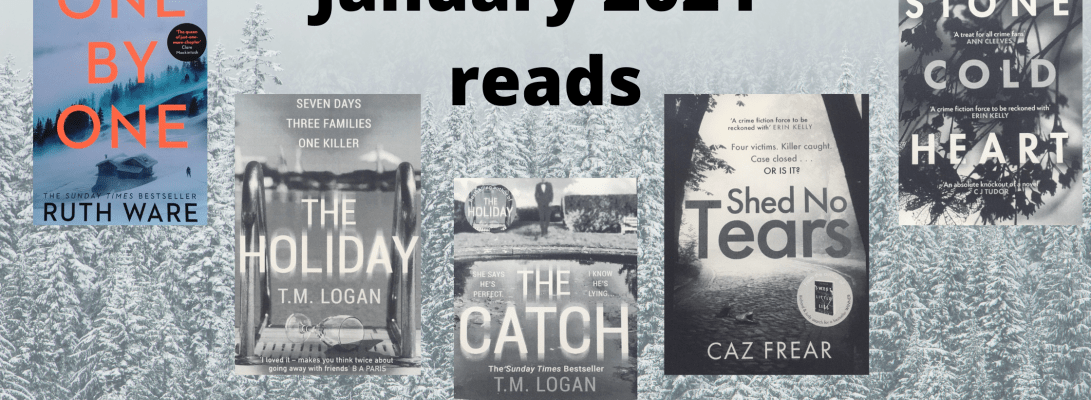
In January, I went on a crime spree and read:

  • The Holiday by T M Logan
  • The Catch by T M Logan
  • One by One by Ruth Ware
  • Sweet Little Lies by Caz Frear
  • Stone Cold Heart by Caz Frear
  • The Murder of Roger Ackroyd (Hercule Poirot #4) by Agatha Christie
  • Shed No Tears by Caz Frear

I really enjoyed The Holiday and loved the setting of the South of France. I have read all of T M Logan’s books now and they are fast-paced and very enjoyable psychological thrillers. I thought the relationships between the friends and their children was very well done and the way the different story strands came together at the end was perfect. I was less keen on The Catch, mostly because I didn’t quite ‘buy’ the premise – an overprotective dad who pretty much stalks his daughter’s boyfriend.

Ruth Ware is one of my favourite writers and the comparisons with Agatha Christie are justified. This was a ‘closed-door mystery’ about a group of colleagues trapped in a luxurious ski chalet by an avalanche. This wasn’t my favourite Ruth Ware but enjoyable none the less.

I had read Sweet Little Lies a few years ago when it first came out but thought I would re-read it in preparation for the next two by Caz Frear. It is the detective in this series – DC Cat Kinsella – that really holds your attention, rather than the individual storylines, but I really enjoyed all three police procedurals, particularly Shed No Tears.

SPOILER ALERT!

I already knew the killer in The Murder of Roger Ackroyd because it is often used as an example of the unreliable narrator and the ‘shock twist’. Even when I was reading it, I was doubting myself though as it is so well done. As always, Christie delivers a masterclass in red herrings and intricate plotting.  

In February, I am moving away from thrillers and planning to read:

  • A Single Thread by Tracy Chevalier
  • The 24-hour Café by Libby Page
  • If I Can’t Have You by Charlotte Levin
  • Somewhere Close to Happy by Lia Louis

Sadly, lockdown has cut off my Agatha Christie supplier (AKA my mum) so I may have to wait until I see her before I continue my Hercule Poirot marathon with The Big Four.

What are you reading? Is lockdown making you read more or less than usual?

The Road to Publication: Remember, the first draft is always sh*t

Wouldn’t it be lovely if you could just start writing and everything that came out of your head arrived in beautiful prose? That the ideas just kept flowing, and it all made perfect sense? How do other writers find it so easy?

The answer is they don’t. Most of the work to produce a novel comes after the first draft, in the seemingly endless rounds of edits.

The best piece of advice I ever received about writing was from a tweet by Caitlin Moran describing her first draft as ‘word vomit’. The idea that a first draft is always sh*t is quite reassuring.

The problem is that you are probably comparing your first draft to a published book which will have gone through several drafts and editorial stages. The finished product on the shelves looks very, very different from the first draft on your computer.

So, let your characters change age, name and gender half-way through. Relax when your setting changes from the South of France to Southport, when your plot veers in strange directions and hangs on unlikely coincidences, when you’re convinced that what you’re writing makes no sense whatsoever and never will.

In your first draft you can leave out scenes altogether and skip to the more interesting parts. You can add backstory that you know you will end up cutting. You can type XXX when you need to do some research. You can bring characters back to life if you killed them off too early. You just have to keep going!

I am nearing the end of the first draft of book three. I hope to have it completed by the end of January. And it is very much ‘word vomit’. It’s not something I would ever let anyone read.

But it’s easier to edit 80,000 of word vomit than it is to edit a blank page.

Photo by Glenn Carstens-Peters on Unsplash

On the shelf: January 2021 reads

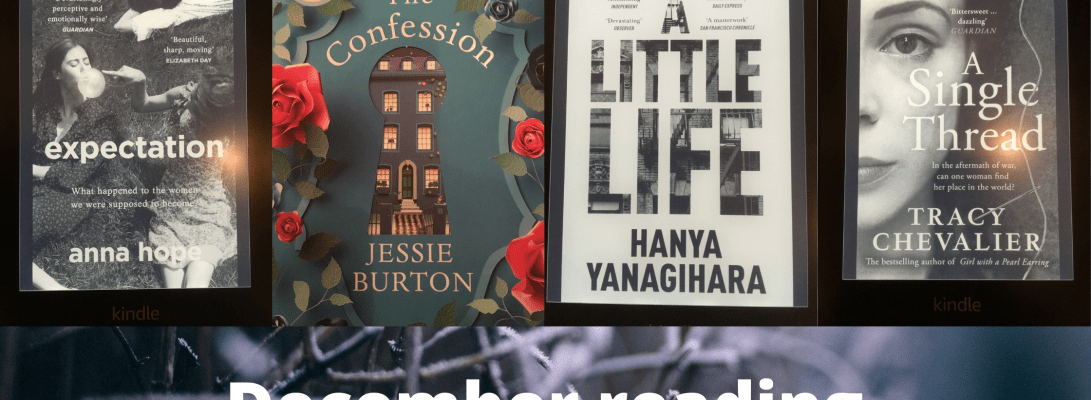
In December, I read:

  • Expectation by Anna Hope
  • The Confession by Jessie Burton
  • The Murder on the Links by Agatha Christie (Hercule Poirot #2)
  • A Little Life by Hanya Yanagihara
  • The End of Her by Shari Lapena
  • Daemon Voices by Philip Pullman

I really enjoyed Expectation – a story that follows three women as they grow up from their student days into their 40s. I could really relate to the characters as they were the same age as me and it gave me lots to think about.

A Little Life is certainly not a little book. Nor is it a particularly cheerful one and I did struggle with it for that reason. It was really well-written, and I am glad I finished it, but I’m not sure I would read it again! Warning – some of the themes in this book are very dark.

I would recommend Daemon Voices to any writers out there – it is a very inspiring examination of art, literature, religion and Pullman’s own work. I didn’t always agree with him, but I thought it was a very thought-provoking and enjoyable read.

In January 2021, I am planning to read:

  • The Holiday by T M Logan
  • The Catch by T M Logan
  • One by One by Ruth Ware
  • Shed No Tears by Caz Frear
  • Stone Cold Heart by Caz Frear

What are your reading plans for 2021?

On the shelf: December 2020

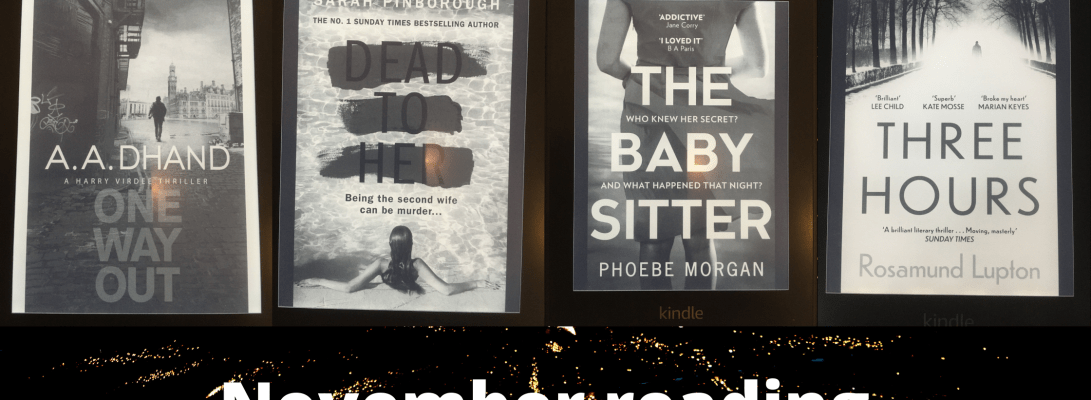
In November, I read:

  • One Way Out by A A Dhand
  • Three Hours by Rosamund Lupton
  • The Babysitter by Phoebe Morgan
  • Dead to Her by Sarah Pinborough
  • The Mysterious Affair at Styles by Agatha Christie (Poirot #1)

The stand-out title for me was Three Hours by Rosamund Lupton which is the story of a high school siege in the UK. At first, I wasn’t sure how realistic this was, but I found myself drawn into the narrative and couldn’t put it down. The story of the two refugee brothers from Syria was very compelling and sensitively done.

Also recommended was One Way Out by A A Dhand. His plots are always so fast-paced, and this was no exception. Another story about a terrorist attack, although quite different from Three Hours. I work in Bradford, so I like the way he uses places and buildings I know very well in his books. I also like the way he weaves big issues into a thrilling plot.  

After signing up to Sophie Hannah’s email newsletter and getting a free guide to the Poirot novels, I decided to revisit the Queen of Crime Fiction and start reading the Poirot novels in order. I must admit I got a bit lost with The Mysterious Affair at Styles. Christie clearly knew her stuff when it comes to poison, but I found that aspect a little over-complicated. She had me going down completely the wrong path when it came to ‘whodunnit’ though!  

If I have time in December I am going to read the next Poirot novel, The Murder on the Links.

In December I plan to read:

  • Expectation by Anna Hope
  • The Confession by Jessie Burton
  • A Little Life by Hanya Yanagihara
  • A Single Thread by Tracy Chevalier

The road to publication: hitting ‘the wall’

After a month away from book three to concentrate on editing book two, I returned to it at the start of November raring to go!

I considered using NaNoWriMo to catch up with the time I had missed but decided against it. In case you have never heard of it, NaNoWriMo stands for National Novel Writing Month and is a writing challenge to write 50,000 words in November. The idea behind it is to write quickly, not worrying too much about the quality, and then you have something to edit by the end. 50,000 words is not really long enough to be a novel but it’s a very good start.  

Some of the benefits of NaNoWriMo are the companionship of others taking part in the challenge, word sprints where you aim to reach a certain number of words in a short space of time, and writing prompts on social media. I know a lot of people who use NaNoWriMo successfully, but I have only tried it once and it wasn’t for me.

I like to plod along, adding to my word count slowly and steadily. I decided instead to aim to write 1,000 words a day for three days then have the fourth day for planning and research so completing around 5,000 – 6,000 words a week. This was considerably more than I was writing in October.

At first it went well but then my lack of planning meant I ground to a halt. I literally did not know what happened next in the plot. My characters were in a dilemma but then they were kind of stuck there and nothing was happening. I knew the ending, but I didn’t know how I was going to get them there.

I took a few days off, brainstormed a few ideas, and then carried on writing. I asked myself what was the worst thing that could happen to my characters now, and what was the best thing? What were they hoping for? What did they fear? Nothing was off the table. I told myself it would be OK to include an alien invasion if that’s what needed to happen to move the plot along. I came up with a few scenes. I wrote some more words.

And then nothing. I have never really experienced writer’s block, and I’m not sure this even counts, but I just couldn’t find any enthusiasm to write. My story was stupid, no-one would want to read it, why was I bothering? I had hit ‘the wall’.

I took the weekend off. I gave myself permission to give up writing altogether or start something new if I wanted to. I felt miserable and tired. I rested. And then this morning, at 3am (thanks insomnia!) I woke up fuelled with ideas. The words started flowing again. I have a feeling it’s going to be a rocky road ahead but at least that word count is heading in the right direction.

What do you do to keep going if you hit a wall? Any tips?

Photo by Tim Mossholder on Unsplash

Inspiration behind The Trip: Stainforth Force

Without wishing to post any spoilers in case you haven’t read it yet, water plays an important role in my debut novel, The Trip.

Rivers are an intrinsic part of the Yorkshire Dales scenery, from small becks to magnificent waterfalls.

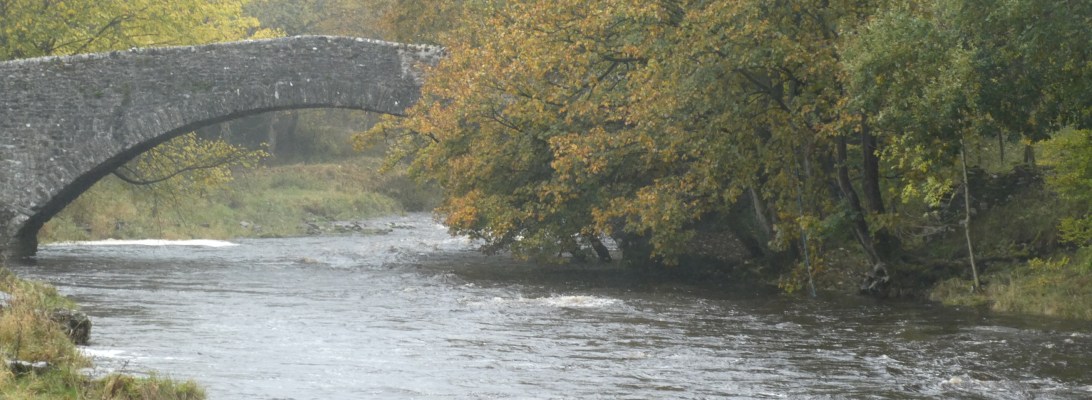
Stainforth Force, just North of Settle, is a great example of a Yorkshire Dales river which is both beautiful but deadly.

The River Ribble seems to meander quite peacefully under the old stone packhorse bridge until it reaches the waterfall where it swirls and crashes against the limestone rocks.

The ancient pack horse bridge at Stainforth Force, which dates back to 1675.
The beautiful waterfall at Stainforth Force

In October, you can see salmon travelling upriver to spawn. Incredibly they manage to resist the force of the water to leap up the rocks. Unfortunately, we didn’t see any this year.

For more information about visiting Stainforth Force, visit https://www.yorkshiredales.org.uk/places/stainforth_force/

On the shelf: November 2020

Last month, I took a break from psychological thrillers and read:

  • The Giver of Stars by Jojo Moyes
  • The Glass Woman by Caroline Lea
  • The Clockmaker’s Daughter by Kate Morton
  • Still Me by JoJo Moyes

My favourite of these was The Clockmaker’s Daughter. It’s been on my ‘to be read’ list since I received a copy for Christmas and I don’t know what took me so long, as I always enjoy Kate Morton’s novels.

The novel follows different households who occupy a grand manor house over 200 years. It includes elements of the supernatural which I really enjoyed. The characters were all quite unexpected and fascinating, particularly the eponymous Clockmaker’s Daughter, who goes from pickpocketing on the streets of Victorian London to becoming an artist’s muse.

The Glass Woman took me a while to get into as it is set in 17th century Iceland. Once I got into it, I was hooked, and I loved all the detail of daily life in such a harsh environment. It has elements of Jane Eyre and Rebecca in it that I loved.  

The Giver of Stars was another book I struggled to get into. It’s beautifully written but I didn’t engage with it as much as I thought I would. Having said that, I have recommended it to quite a few other people. I haven’t finished reading Still Me yet so I will save my thoughts until December.  

I also read a proof of a debut novel called The Chalet by Catherine Cooper. I enjoyed this fast-paced psychological thriller set in the French Alps.  

This month, I am going back to crime and planning to read:

  • One Way Out by A A Dhand
  • Dead to Her by Sarah Pinborough
  • The Babysitter by Phoebe Morgan
  • Three Hours by Rosamund Lupton

Have you read any of these? What did you think?

The Road to Publication: Editing Book Two

So, at the start of September I was writing the first draft of Book Three and aiming to write 3,000 words a week. This was going quite well, and I had just passed the 30,000 words mark when I received a positive response from a literary agent for Book Two!

It wasn’t an offer of representation but some positive feedback about how I could improve the novel. After months of silence from agents, it felt brilliant to have someone come back with an enthusiastic response.

I had a lot of feedback from beta readers and some thoughts of my own to add to the feedback from the agent so I decided to put Book Three on hold and embark on the fifth draft of my second book, provisionally and unimaginatively, called THE WEDDING.  

Thanks to Jericho Writers, I had been introduced to Rachael Herron’s method for revising a book and I decided to give it a go. You can find out more at her website: https://rachaelherron.com/

I wrote down all the feedback from the agent and beta readers on post-it notes and then read through the manuscript making more post-it notes as I went along. By the time I had finished, I had nearly 120 post-it notes.

I then created an Excel spreadsheet with a line for every chapter and columns for the following: Chapter Number; what happens; point of view; time and location; revisions that need to be made; research and character arc. I then inputted all the post-it notes into the relevant columns.

This took a few days but by the end I had a comprehensive editing plan. I can now see at one glance how much work each chapter needs and where the major changes are.

I am aiming to finish draft five by early November using this method and then resubmit to the agent. In the first two weeks I have managed to edit about 25% of the novel so it’s going well.

What methods do you use for editing?

Photo by Colton Sturgeon on Unsplash